Four shifts that could change how ASIC physical design teams reach closure
The most important change may be less about a new tool and more about a new way of working: engineers describe the outcome, while increasingly capable systems help determine how to reach it.
The management question behind the technology
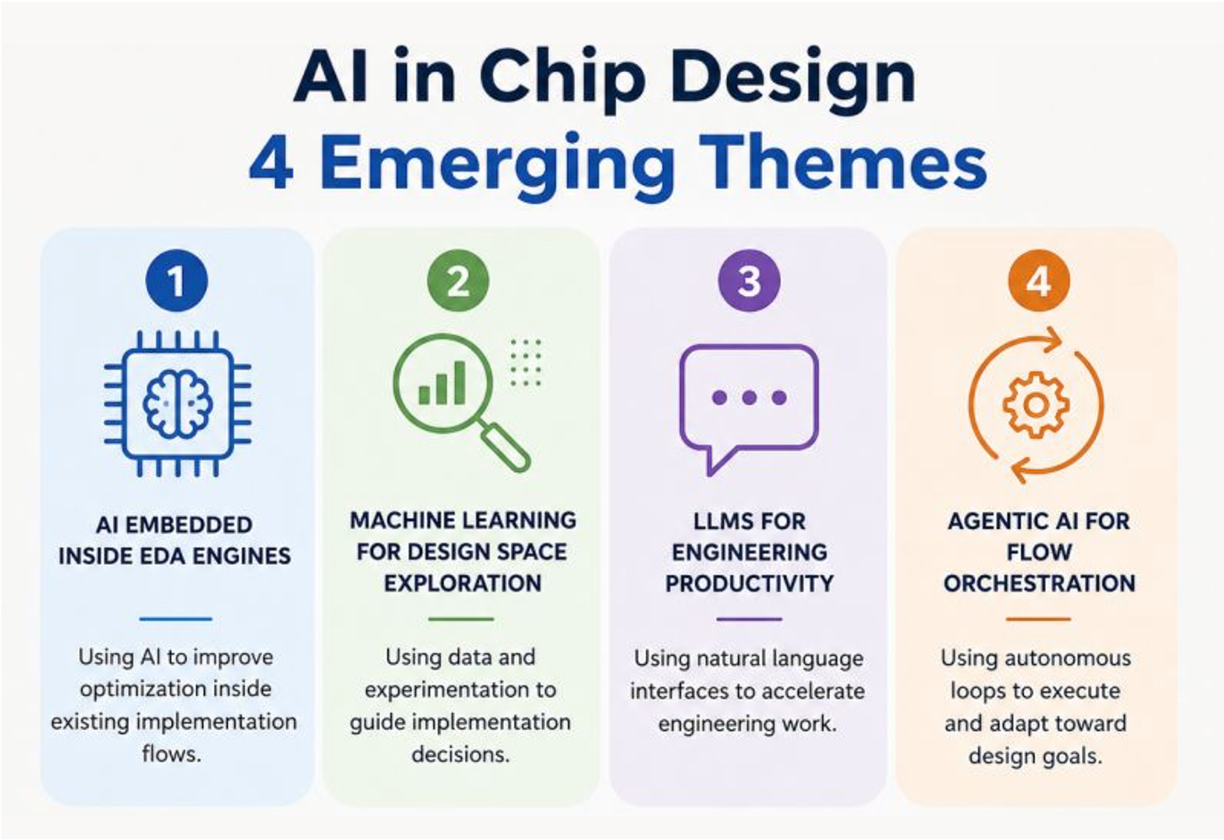
Discussion about AI in chip design often jumps straight to autonomous implementation. That makes for an arresting headline but it compresses several different developments into one idea. A more useful view for project and engineering leaders is to separate the change into four layers: AI embedded in EDA engines, machine learning for design space exploration, large language models for engineering productivity and agentic AI for flow orchestration.
These layers address different bottlenecks. They can mature at different speeds and they do not need to arrive together. Some may be present inside familiar tools without changing the engineer’s interface. Others require new infrastructure, operating controls and ways of defining success. The pace of change is real: the major EDA vendors have moved quickly through 2026 to ship autonomous capability rather than simply preview it, and a wave of newly funded, AI-native entrants is competing alongside them. For engineering leaders, that makes the four-layer lens more useful, not less: it separates genuine operating decisions from vendor momentum.
| LEADERSHIP LENS Identify where AI can reduce unnecessary iteration, preserve engineering focus and improve the predictability of physical design closure. |
1. Smarter decisions inside familiar EDA engines
 Physical design teams care about outcomes: whether the block closes, whether the design meets timing, power, area and DRC objectives and whether signoff arrives on schedule. The optimisation method inside the engine matters because it affects those outcomes, even when the commands and workflow look unchanged.
AI embedded within an EDA engine can improve the choices made during optimisation. It may help identify congestion earlier, select a more promising strategy or avoid spending time on low-value search paths. The engineer may see the same interface, yet the journey to closure can require fewer unproductive iterations.
A single run may not always become shorter. The larger opportunity is to shorten the overall closure cycle. For a manager, that translates into a different set of measures: the number of iterations to reach an acceptable result, the variation between blocks and the predictability of the schedule.
| WHAT CHANGES The workflow quietly improves while engineering ownership remains clear. |
2. A more disciplined search of the design space
 Implementation choices multiply quickly. Utilisation, placement options, clock tree synthesis settings and routing strategies interact. A change that improves timing may worsen congestion. Experience helps an engineer choose the next experiment but a team can still explore only a small fraction of the available combinations.
Machine learning changes the search process. The team runs experiments, captures WNS, TNS, power, area, DRC and runtime results, models how settings influence outcomes and directs the next round towards more promising combinations. Results then feed back into the model.
The objective is not simply to run more experiments. It is to make each run more informative. That makes the definition of ‘best’ a management and engineering decision rather than a tool default. A programme optimised only for timing may spend too much compute or create downstream power and routing problems.
Compute capacity, licences and infrastructure therefore become part of the operating model. Leaders need an agreed objective function, explicit constraints and a method for comparing the value of additional exploration with its cost.
| MANAGEMENT DECISION Define what the optimisation should aim for before scaling the experiment loop. |
3. Less friction between engineering intent and action
 The visible work of physical design sits inside a much larger layer of supporting activity: searching documentation, writing and adapting scripts, interpreting logs, summarising reports and debugging flow issues. These tasks are necessary but frequent context switching interrupts engineering thought.
Large language models can reduce that friction. An engineer can describe the intended outcome, generate a first draft of TCL or Python, ask for the important observations in a report or use a conversational interface to navigate documentation. The value is broader than code generation. It lies in reducing the time between recognising an engineering need and taking the next useful action.
Deployment choices will differ across organisations. Secure enterprise services, internal assistants and other controlled models each bring questions about intellectual property, design data and validation. Whatever the model, generated output still requires engineering review. The design context, constraints and final judgement remain with the team.
| PRODUCTIVITY LENS Measure recovered engineering attention, not just the number of generated scripts. |
4. From task assistance to flow orchestration
 The physical design loop is familiar: run the flow, review the reports, identify the bottleneck, adjust the settings and run again. Agentic AI extends beyond assistance with one step. It can coordinate the sequence around the engineering decision.
This is no longer only a future scenario. Long-running agents that receive an objective, launch an implementation, analyse timing, congestion and DRC reports, adjust an approved part of the flow and initiate the next iteration are already shipping from major vendors, alongside a growing set of specialist AI-native tools. The engineer defines the constraints, sets the success criteria, decides where autonomy is appropriate and remains responsible for signoff. Vendors increasingly describe these capabilities using autonomy-level language borrowed from other industries. Leaders should read such claims carefully: the useful question is not the label attached to a workflow, but how much of the actual design domain it covers, under what conditions it was validated, and what happens when it encounters a case outside that domain.
The capability is arriving faster than most organisations’ governance for it. Rather than adopting a vendor’s autonomy claim wholesale, teams are better served by their own progressive autonomy: starting with narrow, observable loops on their own designs and expanding only when the evidence supports it. The goal is to automate repetitive orchestration so engineers spend more time on judgement-intensive problems.
| OPERATING PRINCIPLE Increase autonomy only where objectives, boundaries, evidence and escalation paths are explicit. |
A practical maturity path
The four themes form a useful progression, although organisations may adopt them in a different order.
- Use embedded AI capabilities where they demonstrably improve implementation outcomes.
- Build a repeatable experimental data set and define balanced objectives for design space exploration.
- Deploy LLM assistance around low-risk, reviewable engineering tasks and capture where time is actually saved.
- Introduce agentic orchestration within bounded loops, with clear approvals, traceability and stop conditions.
This progression also gives managers a clearer way to discuss investment. Tool capability is only one part. Data quality, compute and licence availability, flow observability, security and engineering governance determine whether a promising demonstration becomes a dependable project capability.
What leaders should ask now
- Where does the team lose the most time today: poor optimisation choices, broad design space search, supporting engineering work or orchestration between runs?
- Which outcomes will prove value: fewer iterations, shorter closure cycles, lower variation, reduced compute cost or more engineering time applied to critical problems?
- What design data can an AI system access and what controls are required around scripts, reports and intellectual property?
- Which decisions can be automated safely and which must remain explicit engineering approvals?
- How will the team record recommendations, actions and results so that performance can be audited and improved?
The opportunity is better engineering leverage
AI in ASIC physical design is not one capability arriving in a single wave. It is a set of changes across optimisation, exploration, interaction and orchestration. The immediate gains may be quiet: fewer wasted runs, faster interpretation and less manual coordination. Over time, those gains can combine into a more adaptive flow.
The central management task is to preserve the role of engineering judgement while reducing the mechanics that surround it. Teams that define outcomes clearly, instrument their flows and introduce autonomy deliberately will be better placed to turn AI from an interesting feature into a repeatable project advantage.